Choosing aerospace metal fabrication or stamping is more than a production choice. It affects part performance, repeatability, material handling, inspection planning, and how smoothly an assembly moves through production. For flight-critical parts, small gaps in planning can lead to redesign work, delayed schedules, or concerns that appear after a program is already moving forward.
We recommend making this decision early, before designs, tooling, and supplier plans are locked in. Aerospace OEMs and Tier suppliers need to consider the part’s geometry, expected production volume, tolerances, material needs, and documentation requirements. A process that works well for a simple repeatable bracket may not be the right fit for a large structural housing with several formed and machined features.
Late autumn is also a practical time to review upcoming programs. As teams prepare future production forecasts and new budget plans, they can compare current supplier capabilities, identify possible manufacturing concerns, and make process changes before major milestones arrive.
Aerospace metal fabrication and precision stamping are not interchangeable. Each process has strengths, and the right choice depends on what the completed part must do, not just what it looks like on a drawing.
Fabrication often works well for complex structures, lower-volume requirements, larger parts, and assemblies that need several manufacturing steps. Stamping is often a strong fit for stable part designs that will be produced repeatedly over sustained volumes.
When we review a part, we look beyond its basic outline. Details that can affect the production path include:
Aerospace-grade aluminum, stainless steel, titanium, and specialty alloys can behave differently during forming and finishing. Grain direction, springback, surface protection, and material traceability all deserve attention before production begins.
The full assembly matters just as much as the individual component. A stamped part may still need CNC machining, deburring, coatings, or added inspection before it is ready for installation. On the other hand, a fabricated component may combine several separate pieces into one precision-built structure, reducing the number of assembly steps later.
Our work across metal stamping, CNC machining, fabrication, coatings, deburring, and inspection gives us a broader view of those choices. That makes it easier to compare the complete manufacturing path instead of focusing on only one operation.
Aerospace metal fabrication can be a practical option for complex, low-to-medium-volume flight-critical assemblies. It can bring together cutting, bending, welding, machining, forming, finishing, and assembly work to produce parts with customized shapes and requirements.
Parts with large dimensions, changing wall thicknesses, complicated bends, reinforced areas, or several joined features may be difficult to create efficiently from one stamping die. Fabrication-based methods can be useful for components such as housings, structural panels, mounts, enclosures, brackets, and support pieces.
Fabrication also gives engineering teams room to respond when a program is still changing. Rather than relying immediately on dedicated stamping tooling, a fabricated approach may help support prototypes, qualification phases, repair parts, limited schedules, and design revisions. That flexibility can be helpful when drawings are still being refined or when production needs may change.
Control does not come from the process alone. It comes from documented steps and clear quality checks throughout the work. For aerospace metal fabrication, we focus attention on items such as:
Visual checks alone are not enough for flight-critical work. Dimensional consistency, clean edges, correct material handling, and organized inspection records all help support reliable assembly performance.
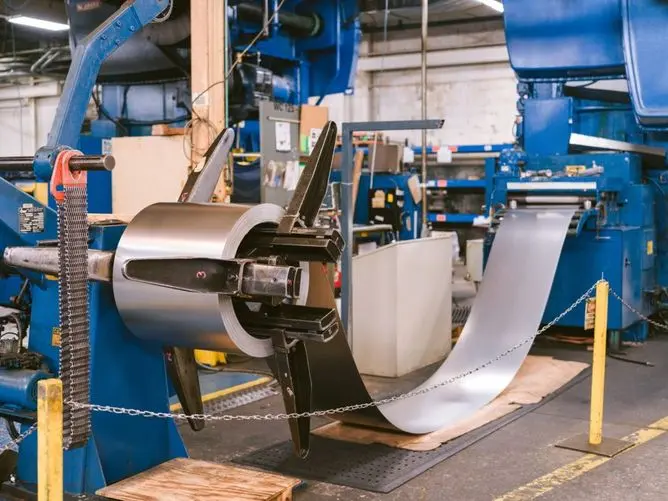
Precision stamping is often a better production path when a component has a repeatable design and steady volume requirements. After tooling is developed and validated, stamping can produce consistent geometry with fast cycle times across recurring runs.
Sheet metal components such as clips, shields, retainers, terminals, mounting plates, lightweight formed panels, and certain brackets may be well suited to stamping. Progressive dies and related methods can combine piercing, trimming, forming, and shaping steps into a more streamlined workflow.
Still, successful stamping begins long before a press cycle starts. Tool design, material thickness, grain direction, springback, tolerances, and feature placement can all affect whether the finished component meets drawing requirements. A small change to a bend, hole location, or formed feature may affect tool design and later inspection needs.
Flight-critical assemblies may also require work after stamping. Depending on the design, a stamped part can need CNC machining for selected features, deburring for edge quality, coatings for surface requirements, or specialized inspection before installation. That is why we encourage early manufacturing review rather than assuming stamping is automatically the simplest answer.
In some cases, a hybrid approach makes the most sense. Stamping may create the core shape efficiently, while machining finishes a precise feature or fabrication adds another component to the assembly. Looking at the whole process helps protect both part performance and production reliability.
Before finalizing a design or committing to tooling, aerospace teams should compare fabrication and stamping against the real needs of the part. The best choice supports intended performance, inspection requirements, production volume, delivery planning, material needs, and the full lifecycle of the assembly.
A manufacturing plan is stronger when each step is considered together, from material preparation through finishing and inspection. That includes asking whether a part can be simplified, whether secondary work is expected, and whether the selected process can remain repeatable as production requirements change.
For flight-critical assemblies, the clearest path is usually the one that identifies risks early, documents key requirements, and matches each feature to the process best suited to produce it.
Banner Metals Group Inc. provides aerospace metal fabrication support tailored to demanding assembly requirements. Our team can help evaluate material, geometry, and production needs to support consistent, reliable results. Contact us to discuss your next aerospace project.