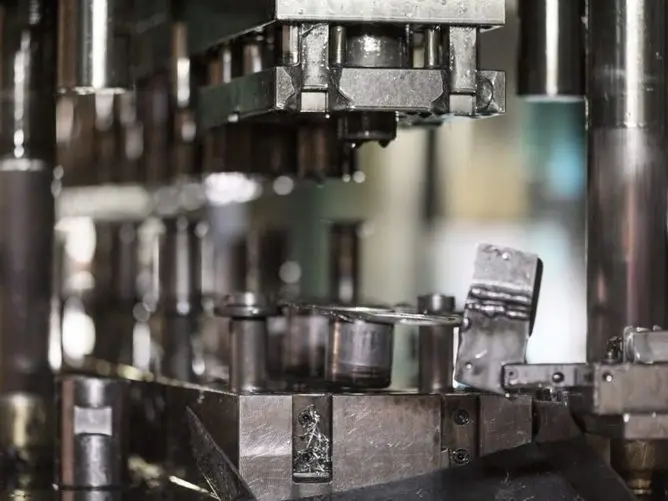
Well-maintained stamping tools help us protect part quality before a defect reaches your production line. Every press cycle depends on tooling that cuts, forms, and guides material as intended. When wear is caught early, we can reduce the risk of burrs, cracks, dimensional drift, and inconsistent edges in metal stamping components.
Tool care also affects delivery performance and production stability. A small problem in a punch or die can quickly become scrap, rework, or an unexpected press stoppage. That is why we treat maintenance as part of the quality process, not as a task to postpone until something fails.
The condition of a stamping tool has a direct effect on the parts it produces. Punches, dies, guide pins, bushings, stripper plates, springs, and fasteners all work together during each cycle. If one feature begins to wear, loosen, or shift, part accuracy can change.
Even minor tool wear may affect hole location, edge quality, flatness, bend consistency, and repeatability. In high-volume runs, a small variation can be repeated across many metal stamping components before it is noticed. We focus on catching those changes early so parts continue to match the intended drawing and functional needs.
Waiting for a full tool failure can create difficult production problems, including:
Proactive maintenance gives us more control over those risks. This matters when supporting demanding work for aerospace, automotive, EV, solar, defense, and commercial equipment manufacturing. Our precision metal stamping, CNC machining, fabrication, deburring, coatings, and dimensional inspection capabilities all depend on reliable processes, beginning with reliable tooling.
A calendar can be helpful, but it should not be the only thing guiding tool maintenance. Different tools face different conditions based on production volume, material type, part shape, press setup, lubrication, and the history of prior repairs.
We track press strokes, production runs, inspection findings, and repair records to help determine when a tool needs attention. A high-volume stamping tool may need inspection or sharpening much sooner than tooling used for a short run or prototype work. The goal is to service a tool based on what it has actually done, not only on the date of its last review.
Material also changes the maintenance picture. Stainless steel, high-strength steel, aluminum, copper alloys, and coated materials can all produce different forms of wear. Thickness, forming demands, surface finish requirements, and lubricant choice can affect how long punch edges and die surfaces hold up.
Autumn is often a practical time to review tooling performance. As year-end demand and first-quarter planning take shape, we can look for tools that need maintenance during planned downtime. This kind of preparation helps protect available capacity when production schedules become busier.
Tool maintenance and part inspection should work side by side. Looking only at the tool may miss a developing dimensional trend. Looking only at finished parts may delay the discovery of the tooling issue behind that trend.
During inspections, we pay close attention to working surfaces and alignment features. Punch edges, die openings, guide pins, bushings, stripper plates, springs, and fasteners all deserve review. Worn or misaligned components can lead to uneven cuts, burr formation, slug pulling, distorted material, and premature damage to the tool.
Finished-part checks help confirm that metal stamping components remain within their required tolerances throughout a run. Depending on the part, we may review:
Inspection results can point us toward the right maintenance action. For example, a gradual shift in hole size may suggest punch wear, while inconsistent edge condition may indicate clearance or alignment concerns. Those early signals allow us to inspect the source before a small issue spreads through a larger production run.
Day-to-day care has a major effect on tool life between planned repairs. A tool can be made correctly and still develop avoidable problems if debris, moisture, friction, or poor handling are allowed to build up.
Cleaning is one of the simplest ways to protect working surfaces. After production, we remove metal slugs, lubricant residue, dust, and other debris that can interfere with clearances. Foreign material left in a die can damage surfaces or create inconsistent cutting and forming results during the next run.
Lubrication deserves the same level of attention. The right lubricant helps reduce friction, heat, galling, and wear, but the choice must fit the job. We consider the material being stamped, forming complexity, desired surface finish, downstream coating needs, and customer specifications before selecting a lubrication approach.
Storage and transfer procedures matter as well. Tools should be clearly labeled, protected from corrosion, stored in controlled locations, and handled safely between runs. These practices become especially important during slower periods, planned maintenance windows, or transitions between production programs.
Maintenance becomes easier to manage when decisions are based on real production and inspection information. Instead of responding only after a press stops, we can watch for patterns that suggest a tool is nearing the point where service is needed.
Useful maintenance indicators include press strokes, repair frequency, scrap levels, setup time, dimensional trends, and tooling-related downtime. When the same issue appears repeatedly, the solution may involve a different maintenance interval, a replacement component, or a closer review of the tool design and operating conditions.
Clear repair records also help us learn from each event. Documenting what was repaired, what caused the issue, and which replacement parts were used gives our teams a stronger basis for future planning. It also makes it easier to spot repeat concerns that may not be obvious during a single production run.
Coordination matters here. When maintenance, quality, and production planning work from the same information, repairs can be scheduled at less disruptive times. That helps us protect delivery commitments while reducing the chance of an unexpected press stoppage.
Disciplined tool maintenance protects much more than the tool itself. It supports consistent part quality, lower scrap, steadier production schedules, and longer-lasting manufacturing assets. For demanding metal stamping components, that consistency can make a meaningful difference from the first piece through full production runs.
Before year-end demand increases, it is worth reviewing tooling records, inspection trends, lubrication practices, and storage procedures. Small improvements in these areas can help prevent avoidable defects and keep production moving with fewer surprises.
At Banner Metals Group Inc., we provide dependable metal stamping components built to support consistent quality and efficient production. Our team can help you align material selection, tooling needs, and manufacturing requirements for your application. To discuss an upcoming project, contact us today.